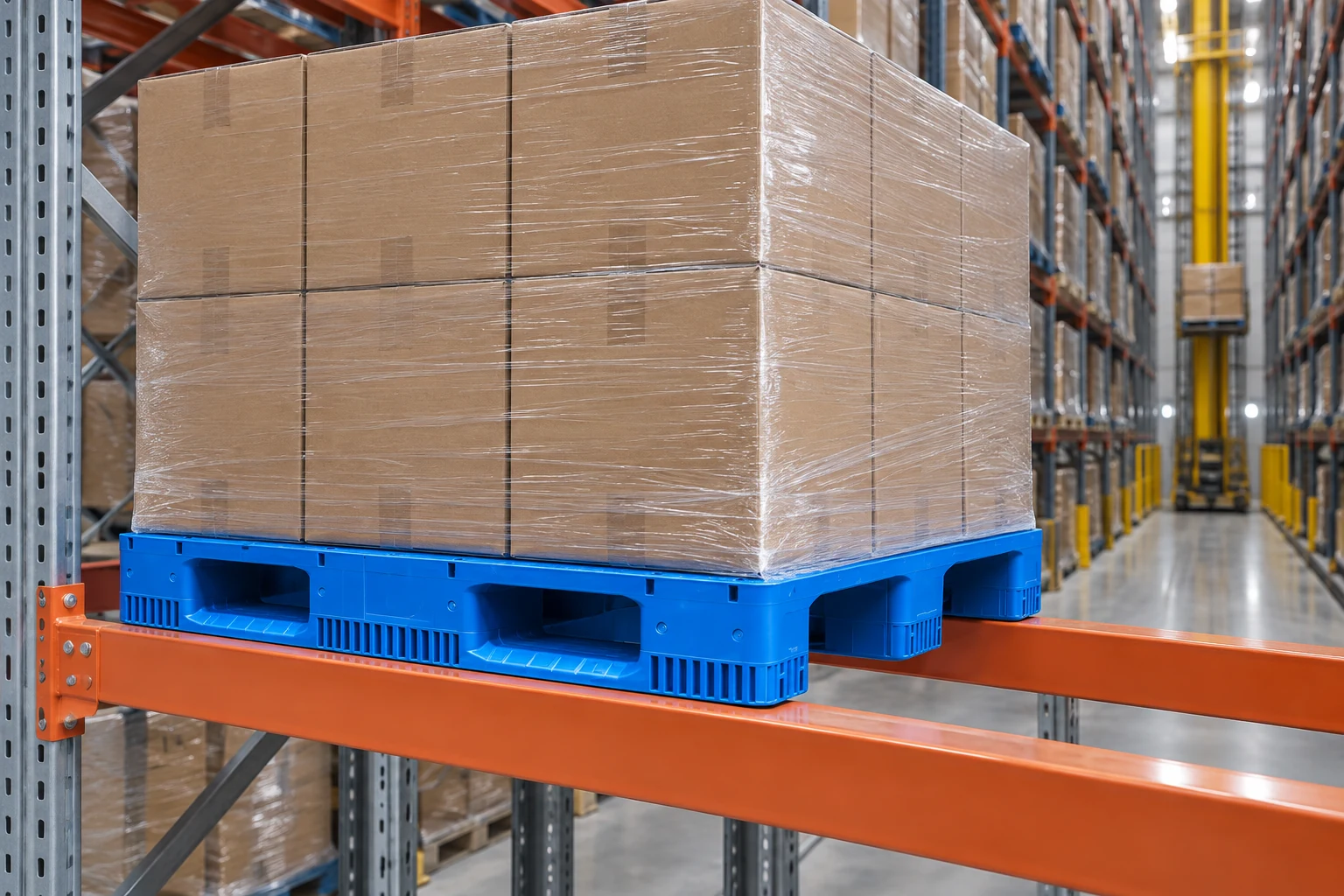
Storing a 1,200 kg Unit Load in High-Bay Racking: How Should Reinforcement Be Specified?
A high-bay warehouse is being planned for dense boxed goods. The working unit-load figure is 1,200 kg, and some pallets may remain in a rack position for up to three months. The purchasing question sounds straightforward: how many steel tubes are required, and which pallet can carry the load?
This is an illustrative engineering scenario, not a specific customer project. The 1,200 kg figure is an input to the discussion, not a rated rack-load claim for any BAOHENG model. Final specifications require full application review and representative testing.
Total mass is only the starting point
Two unit loads with the same mass can act very differently on a pallet. A complete layer of flat-bottom cartons may distribute force across much of the deck. A few dense containers, reels or small-footprint bins can concentrate the same mass into limited areas.
The project therefore needs a load map, not just a weight label. It should identify:
- the actual contact area between the load and the deck;
- individual package weights and stacking pattern;
- any offset loading or displaced center of gravity;
- stretch wrapping, strapping and anti-slip measures;
- any permissible package settlement or movement.
Without this information, adding more steel may increase cost and pallet tare weight without reinforcing the span that matters.
Rack support defines the working span
In a storage location, a pallet is rarely supported across its full underside. The clear distance between the beams, beam width and pallet position establish the effective span. Moving the same pallet to a wider opening can materially change its deflection response.
Rack-load values are only comparable when the support conditions are comparable. The approved drawing should show the clear span or beam centers, contact width and pallet-positioning tolerance. Where a shuttle or support rail is involved, its contact geometry and any brief unsupported condition during transfer must also be reviewed.
Time and temperature belong in the specification
HDPE responds to sustained load and temperature. A short static test can reveal an obvious structural issue, but it cannot by itself represent weeks or months in storage. A warm warehouse, seasonal heat and a subzero cold store should not be treated as equivalent conditions.
The validation plan should state sample-conditioning temperature, load duration, measurement points, acceptance limits and the method used to observe recovery after unloading. Website values can help shortlist a pallet platform; final approval should be based on the agreed drawing, configuration and test method.
Standard structure or reinforced structure?
For a project requiring a continuous deck, a wider support span or a concentrated load, the reinforced solid three-runner range may be an appropriate starting point. Its deeper structural sections and expanded steel-tube capacity provide more options for directing stiffness along the critical load path.
“Reinforced,” however, is not a substitute for application review. A deeper pallet can conflict with a tight conveyor height window. Added steel increases tare weight and may affect machine capacity, manual handling, freight density and corrosion requirements. Where two versions share the same plan dimensions but use different structural depths, the choice should follow the equipment envelope and working span.
Tube count is not a standalone answer
Steel tubes are most useful when their direction and position correspond to the bending path. Deck tubes can help transfer load toward the support lines, while runner tubes may affect the stiffness and contact behavior of the base. Quantity, section, orientation, location and surface treatment need to be locked together on the approved drawing.
A practical sequence is:
- map the load footprint and principal bending direction;
- mark the rack and machine support lines;
- shortlist the structural depth and available tube positions;
- check that tubes do not conflict with openings, sensors or clearances;
- test a representative sample in the final configuration.
Decision outcome
For this illustrative 1,200 kg project, the correct output is not a generic answer such as “use eight tubes.” It is a controlled configuration: pallet model, structural depth, tube layout, load map, support span, temperature range and validation method.
Before comparing heavy-duty options, read Rack Load Is Not a Single Number. Then send the load footprint, storage-support drawing and maximum dwell time through Contact for a project-specific review.
