Rollers, Chains and a Turntable: Three-Runner or Full-Perimeter Pallet?
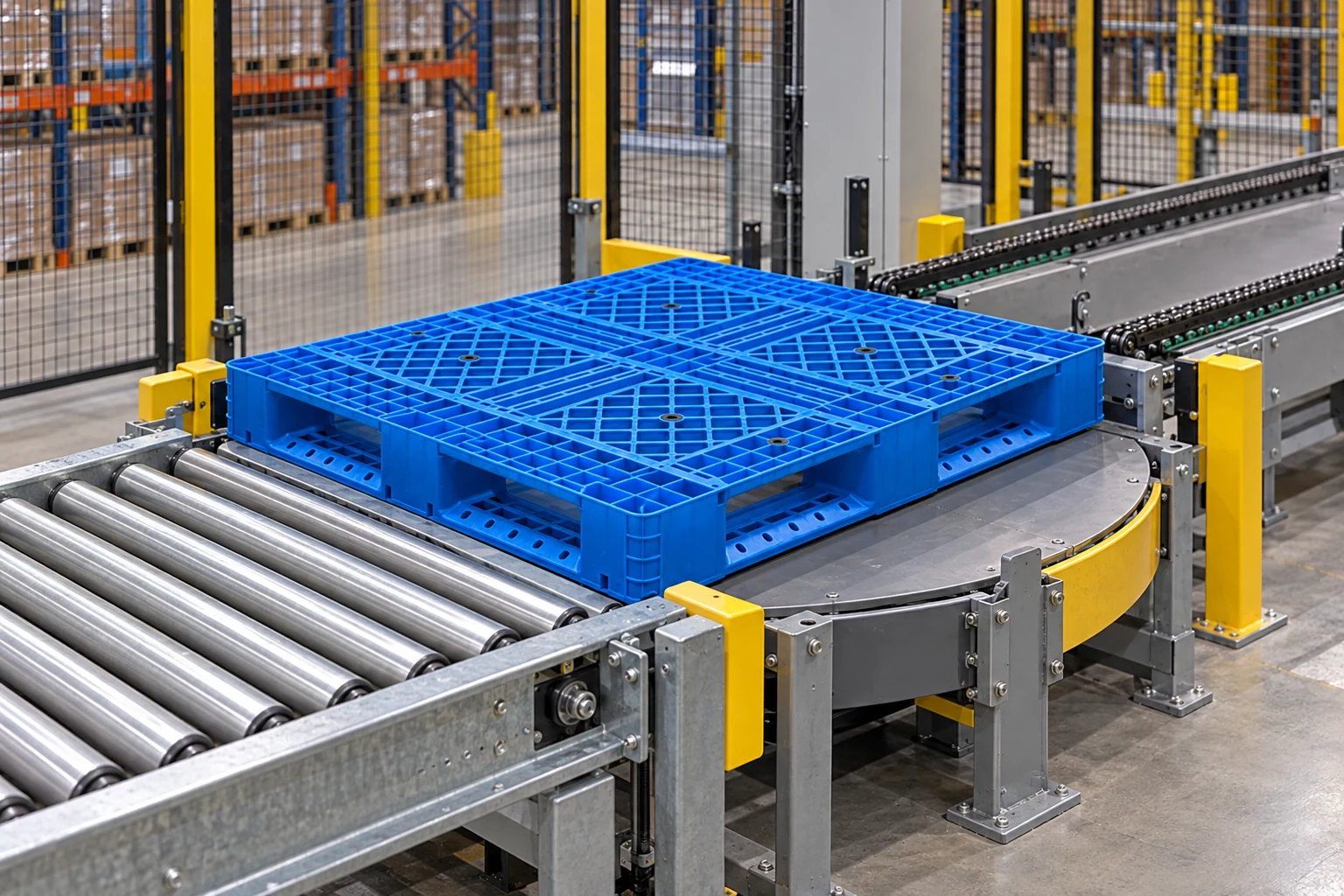
An automated inbound route combines roller conveyor, twin-chain transfer, a weighing station, a turntable and a stacker crane. The project team wants to freeze the pallet base early. Three runners provide a clear travel axis; a full-perimeter base provides more continuous edge contact. Which layout is the safer choice?
This scenario combines equipment commonly found in automated material-handling projects. It is not a specific customer installation, and its conclusions do not replace drawing review and loaded trials.
Select the base from the route, not the catalogue
Either layout may appear suitable when a single conveyor section is considered in isolation. Problems more often emerge at transitions: the leading edge has left the rollers while the rear is not yet fully supported by the chains; the turntable changes the pallet orientation; or a stop meets an opening instead of a reinforced face.
The first project document should therefore be a route drawing. It should identify travel direction, support elevation, roller pitch, chain centers, transfer gaps and pallet orientation at every station.
Roller conveyor: maintain contact through movement
Rollers need to provide adequate support as the pallet moves, not only when it is parked. Large underside openings or widely spaced rollers can leave too few contact points at a transition, producing pitch, vibration or local impact.
A full-perimeter base often provides more usable edge contact. Three continuous runners can create equally clear support lines when the rollers and travel direction are arranged for them. The deciding factors are the roller orientation, pitch and geometry of the transfer—not a generic preference for one base style.
Chain conveyor: align the runners with the tracks
Twin- or multi-chain conveyors require the pallet-bearing lines to align with the chain tracks. A chain running under an opening, narrow rib or edge detail will not provide stable support. Three-runner pallets make the principal travel axis easy to define, provided the runner spacing agrees with the chain centers.
For a grid three-runner pallet, the review should also confirm that fork openings, ribs and optional steel do not interfere with the lift-transfer mechanism. For a grid full-perimeter pallet, check that the perimeter frame clears guides and remains supported as it crosses the gap.
A turntable changes the meaning of travel direction
If the turntable changes only the orientation of the load while downstream support remains on the original pallet axis, a three-runner layout may retain a clear interface. If the pallet exits at 90 degrees, the post-turn contact pattern needs separate review.
A full-perimeter base can be more accommodating where edge contact is needed after rotation, but it is not an automatic approval. Turntable diameter, centering method, guard clearance and sensor targets before and after rotation all belong on the same interface drawing.
Stops, weighing stations and sensors are easy to overlook
A stop needs a strong, repeatable contact face. A weighing station needs a defined set of support points. A photoelectric sensor needs a stable target surface. Changing the pallet base may affect these secondary stations before it causes any problem on the main conveyor.
The trial plan should include:
- empty-pallet passage through every transition at controlled speed;
- positioning and sensor checks before and after rotation;
- representative light, heavy and offset unit loads;
- repeated cycles to observe tracking, impact and abnormal noise;
- a final drawing that fixes pallet orientation and equipment settings.
Decision outcome
Where the complete route retains one travel direction and the chain tracks align with the runner positions, a three-runner pallet often provides the clearest operating logic. Where the pallet changes direction and requires perimeter contact, a full-perimeter base may offer an advantage. In either case, the least forgiving transfer point should drive the decision.
See How to Specify a Pallet for Conveyors and Shuttles for the core interface data. If equipment drawings are available, submit roller pitch, chain centers and transfer details through Contact.
