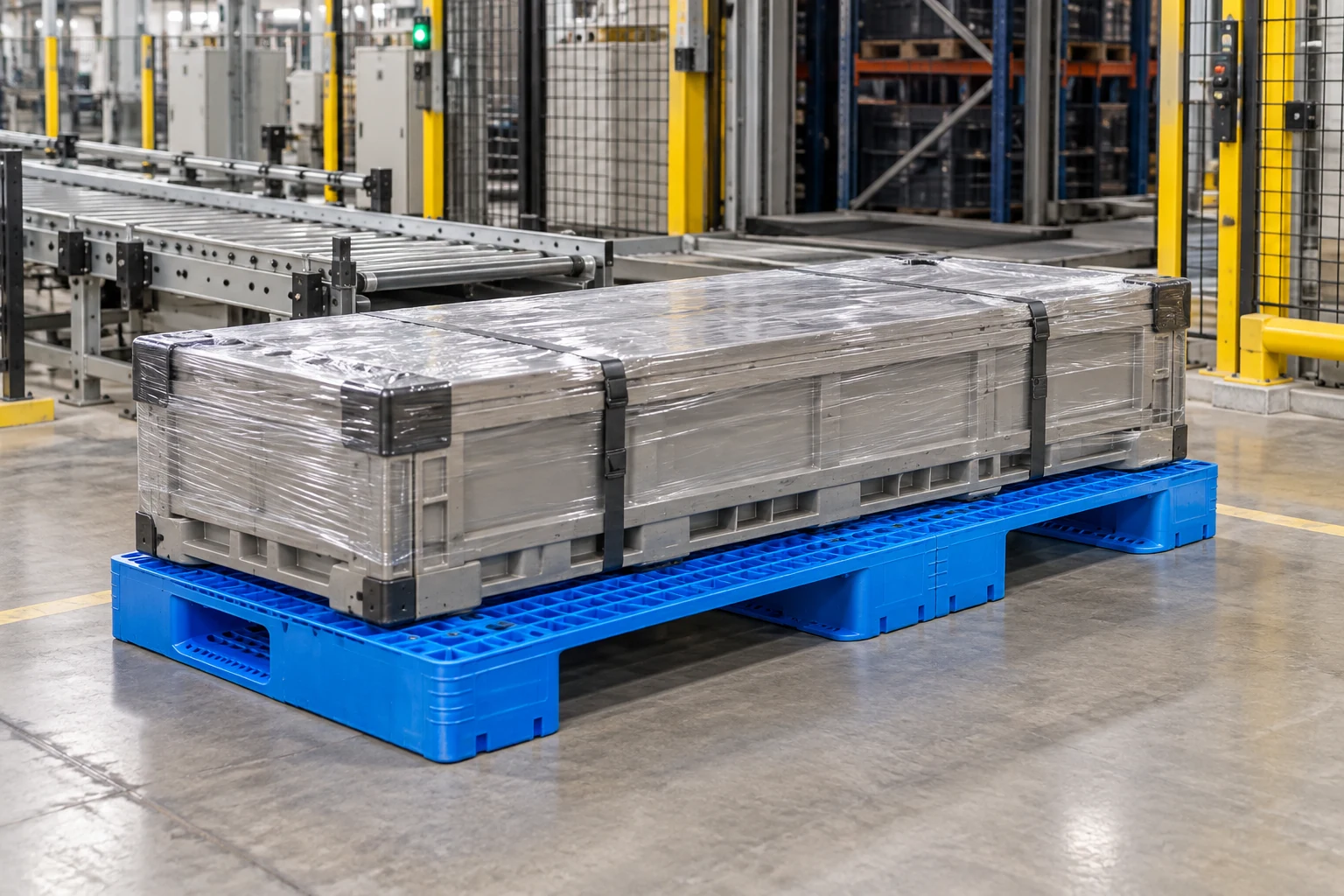
When the Load Is Longer Than a Standard Pallet: Accept Overhang or Move to a Larger Platform?
An industrial-parts warehouse needs to store long cartons and returnable containers whose footprint extends well beyond a common 1200 mm pallet. One proposal keeps the standard pallet and accepts overhang at both ends. Another moves to a 1500, 1600 or 1800 mm pallet that more closely matches the load.
This scenario combines requirements found in large-format projects. It does not describe a particular customer installation. Pallet size must be reviewed with load distribution, equipment capacity and representative testing.
Overhang changes the load path
When the product extends beyond the deck, the unsupported portion must bridge back to the pallet. A rigid returnable container may do this without immediate difficulty. A long carton, panel pack or flexible container may bend, shifting more force toward the pallet edges.
The review should capture the stiffness of the packaging, bottom contact points, center of gravity and allowable product deflection. The unit load cannot be treated as a perfectly rigid, evenly distributed block. Nor can additional pallet reinforcement compensate for missing support beneath a flexible product.
The load can exceed the machine envelope before the pallet does
Automated storage systems are sensitive to the complete unit-load envelope. Product overhang may affect:
- guide rails and side clearances on conveyors;
- whether a centering device can still reach the pallet body;
- edge-detection and overhang sensors;
- fork clearance during stacker-crane pickup and placement;
- uprights, neighboring loads and fire-protection clearances;
- the behavior of stretch-film tails and package corners in motion.
The pallet itself may fit the system while the assembled load does not. Both outlines need to be shown on the interface drawing.
A larger pallet also changes the system
The grid three-runner range includes several large-format options that can reduce unsupported product overhang. Increasing pallet size, however, triggers a new set of checks.
Conveyor width, transfer length, turning radius, lift capacity, stacker-crane payload, storage pitch and empty-pallet stacking all may be affected. Pallet tare weight must be added to the product mass when checking machine capacity. A better-supported load is not a complete solution if the larger carrier exceeds the operating envelope.
Decide whether to change the packaging or the pallet
If only a small number of exceptional products are involved, a redesigned inner pack or rigid reusable skid may be more economical than introducing a second system pallet. If long products represent a large, stable share of throughput and the warehouse can be designed around them, a pallet that follows the load footprint may provide a clearer interface.
Three questions provide a useful first screen:
- Can the product bridge the proposed overhang without exceeding its allowable deformation?
- Does the complete unit load remain inside every machine, storage and safety envelope?
- If a larger pallet is used, do machine capacity and storage density remain acceptable?
If any answer is based on assumption rather than measured data, the project is not ready for volume purchasing.
Validate length, not just mass
A large-format sample trial should focus on long-axis deflection, leading- and trailing-edge support during transfers, repeatable positioning and load restraint. The test load should reproduce the real length and center of gravity. A compact stack of test weights can match total mass while creating the wrong load path.
Freight and replenishment also deserve early attention. Large pallets change container loading density, empty stacking height and on-site storage space. Bringing these supply-chain constraints into the specification prevents a technically workable design from becoming an expensive long-term standard.
Decision outcome
There is no universal rule that overhang must always be eliminated, and no reason to force a standard pallet into every application. The comparison should combine packaging stiffness, support coverage, unit-load envelope, storage efficiency, pallet tare weight and replenishment logistics.
For loads in the 1400–1800 mm range, send the product dimensions, underside photographs, center of gravity, handling route and storage clearances through Contact. These inputs help determine whether the better first move is to change the pack, the pallet or both.
