Forklift or Pallet Jack? Check AS/RS Pallet Fork Entry Before Ordering
A forklift can enter a pallet while a pallet jack's load wheels still meet an obstruction. Review each vehicle and each entry side before ordering.
In this guide
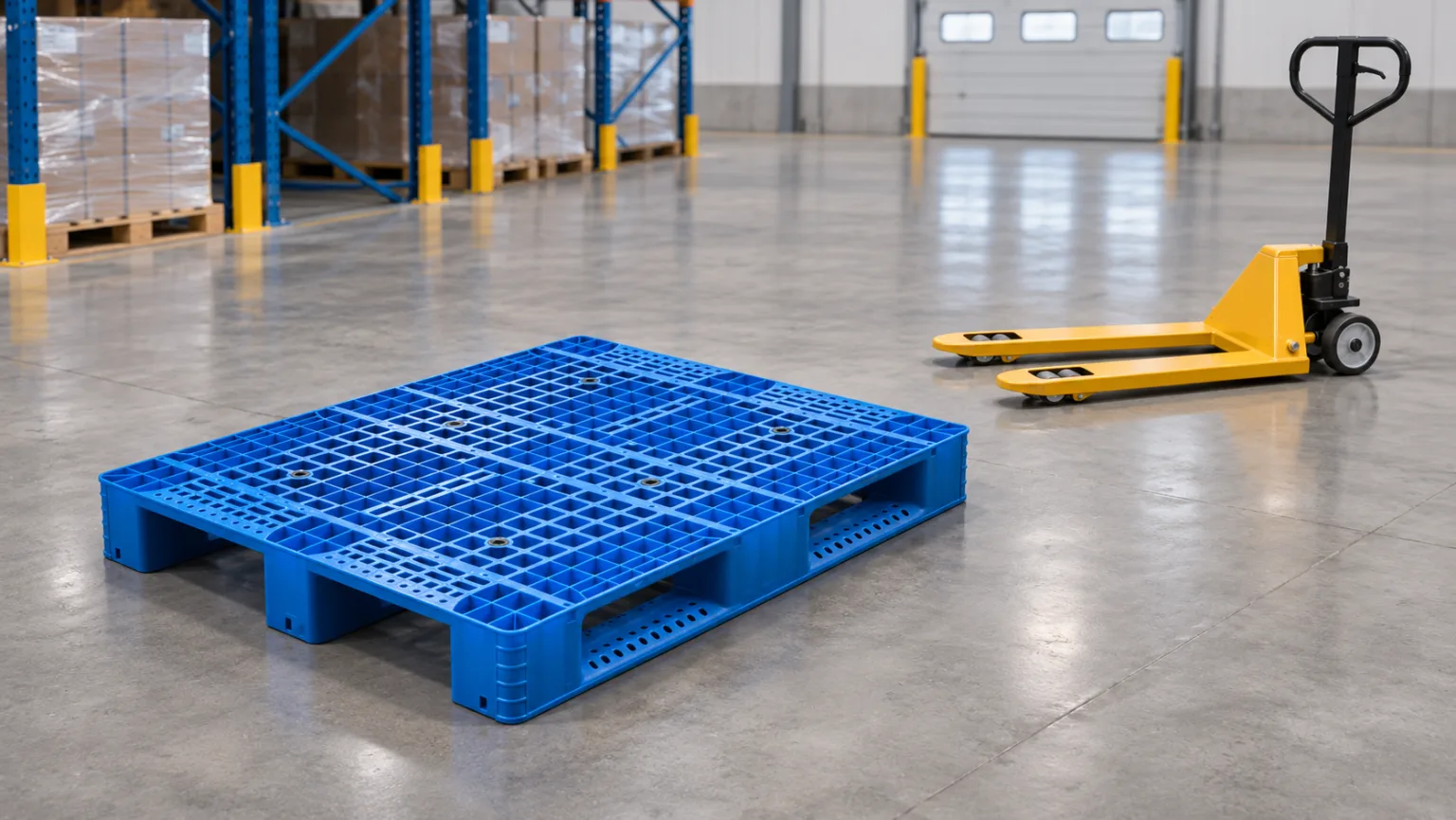
Check the whole pickup movement for every vehicle and entry side: the fork blades must enter the actual openings with the required clearance, support the intended load, and withdraw without interference. For a manual or powered pallet jack, the load wheels and lifting linkage also need a suitable path and position. A four-way entry label alone does not establish all of those conditions.
This decision is about the interfaces between a pallet and the fork vehicles on its route. The conveyor and shuttle guide covers support and handover on automated equipment; both reviews may be needed for the same purchase.
1. List the vehicles and approach sides
Draw the route from receiving through loading, storage, replenishment and dispatch. Identify the exact forklift, hand or powered pallet truck, automated fork vehicle and other pickup devices used at each stage. Mark a reference side A on the pallet drawing and record which side each vehicle approaches, including return and exceptional handling routes.
| Pickup equipment | What needs a separate review | Why a previous pass is not enough |
|---|---|---|
| Forklift | Fork length, blade width and thickness, spacing, approach and clearance | A different fork or entry side can change the contact and support. |
| Manual or powered pallet truck | Lowered fork profile and spacing, fork length, load-wheel and linkage positions, lift and exit | Its load wheels move relative to the pallet base during lifting. |
| Automated fork pickup | Actual pickup geometry, approach, positioning and the complete movement envelope | A manual pickup does not prove automated alignment or clearance. |
Some operations use a hand pallet jack only in a maintenance area or on outbound loads. If it is part of the intended route, identify its specific model and include it in the review; do not assume it works just because a forklift does.
2. Match each fork to the actual openings
Request a dimensioned side and underside drawing for the exact pallet family, model, configuration and drawing revision. On each required entry side, mark the clear width and height of each usable opening, internal obstructions, bottom members and reference edges. Measure the actual sample and record measurement points and applicable tolerances, not just the pallet’s outside length and width.
For each vehicle record the fork length, individual blade width and thickness, and adjustable or fixed spacing. State whether spacing is measured between inside edges, outside edges or centrelines. Compare the full blade profile and intended fork positions with the openings along the complete insertion and withdrawal path. Where guides, tapered fork tips, load overhang or positioning variation matter, ask the equipment supplier to include them in its drawing review.
Check how far the forks support the load and whether fork tips could interfere with adjacent loads, rack parts or other equipment. Fork length must be considered with the pallet, load and vehicle together. Follow the equipment and site operating instructions; do not turn an opening measurement into a universal fork-length rule or load approval.
3. Check the pallet jack’s wheels and lift movement
A pallet jack has load wheels near its fork ends and a lifting linkage. Record the wheel locations and the fork’s lowered and raised profiles for the actual truck. Mark the pallet base members, openings and floor position in the same view; ask the truck and pallet suppliers to check what happens as the fork enters, the wheels move through the lift, the load travels, and the fork lowers and exits.
HSE’s Pallet safety guidance, fourth edition, page 8, warns that pallet-truck finger wheels can damage base boards and illustrates the problem. Toyota’s hand pallet jack overview describes load-wheel positions and their linkage. These are reasons to review the actual wheel path, not proof that a particular BAOHENG pallet and truck combination is suitable.
If an opening is too low, a blade catches, a wheel or linkage meets a base member, or adequate support cannot be demonstrated, hold that combination for review. A different truck configuration or pallet design may be worth discussing with the respective suppliers; never remove pallet material or alter equipment without the responsible parties’ approval.
4. Agree a representative sample review
Use the proposed production configuration and identify each sample. Have the equipment and site owners define safe trial conditions, permitted operators, representative load and restraint, route, entry sides, sample quantity and acceptance criteria before starting. Review geometry first; an empty insertion check alone does not reproduce a loaded unit or establish handling capacity.
Record the vehicle model and fork setup, pallet identity, entry side, load, observation and outcome for insertion, pickup, travel, lowering and withdrawal. Include positioning and detection where automated pickup is involved. Stop and hold the affected unit under site procedures if there is catching, unexpected contact, damage or instability. Keep untested vehicle and side combinations pending; the sample acceptance guide connects the findings to rack and conveyor checks.
5. Send an enquiry the suppliers can answer
Contact BAOHENG with the required quantity, candidate pallet family and model, load and route. Attach the entry-side drawing or photos and the forklift and pallet-truck model information, fork dimensions, wheel layout and any available equipment drawings. Ask for the relevant pallet opening drawings and configuration options; the pallet, vehicle and system owners remain responsible for agreeing compatibility and project acceptance.
Sources and scope
- HSE, Pallet safety, PM15, fourth edition, page 8: pallet-truck finger-wheel interference and base damage.
- Toyota Material Handling, Anatomy of a Hand Pallet Jack: load-wheel placement and lift linkage.
Sources reviewed 27 November 2026. This is a planning guide, not a model-specific test result, operating instruction or universal clearance requirement.
