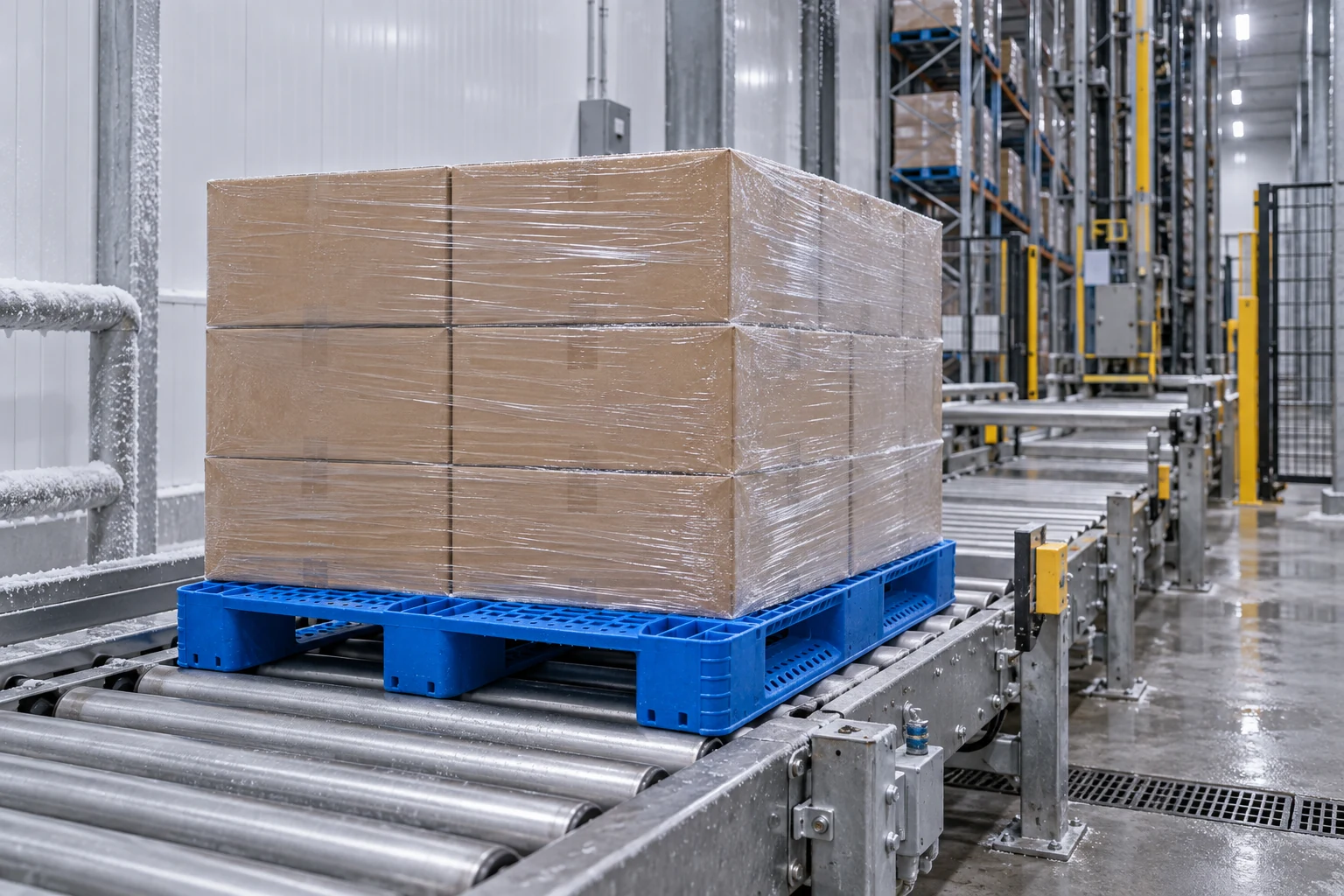
Subzero Storage, Condensation and Automation: What Should a Cold-Store Pallet Specification Cover?
An automated cold store receives unit loads assembled in an ambient staging area and conveys them into subzero storage. Each pallet experiences temperature changes, condensation, lift-truck handling and extended rack dwell. The initial requirement says only “low-temperature plastic pallet,” which is not enough to define the application.
This is an illustrative cold-storage scenario, not a specific customer installation. It does not establish a material temperature rating or load guarantee. Actual temperature range, cycle frequency and validation conditions must be reviewed for each project.
Separate continuous cold exposure from thermal cycling
A pallet held at a stable subzero temperature faces a different duty cycle from one that repeatedly moves between ambient and frozen zones. Frequent transitions add condensation, possible icing and changes in surface friction. They may also affect labels, sensor response and packaging behavior.
The specification should state minimum and maximum operating temperatures, time spent in each zone, expected cycles per day and whether test samples must be conditioned at the operating temperature. A single static test performed at room temperature cannot represent the complete cold-store route.
A grid deck supports airflow and drainage—not every load type
The open surface of a grid three-runner pallet can support airflow, drainage and visual inspection while reducing broad areas where water might collect. That makes it a logical candidate for many cold-store projects.
Its suitability still depends on the unit load. The bottom of a carton or reusable container must span the openings without local instability. Flexible sacks, small-footprint cases or moisture-softened packaging may require more continuous support. Where a solid deck is preferred, drainage and slip control need to be addressed separately.
Condensation affects the load, pallet and equipment
Moisture can reduce friction under cartons and create a wet interface between the pallet and conveyor. Anti-slip elements only help when they are positioned under the actual load footprint. The project should identify likely collection points, floor and machine drainage, and whether film tails or wet packaging can enter moving equipment.
Sensors also need to be tested in representative conditions. A target surface may behave differently when wet, frosted or viewed against a reflective cold-room background. Approval should use the final color and surface geometry in an environment close to actual operation.
Automation interfaces remain central
Low-temperature requirements do not override conveyor requirements. The pallet must maintain predictable contact across rollers, chains, lifts, stacker-crane forks and storage supports. Dimensional stability after temperature conditioning also matters where centering and clearance windows are tight.
If steel reinforcement is included, tube material, finish, enclosure and placement should be confirmed as part of the cold-store environment. The final sample should use the intended structure, color, anti-slip components and reinforcement layout.
Build the validation plan around three groups of conditions
- Environment: temperature conditioning, condensation, drainage and repeated thermal transitions.
- Unit load: least favorable center of gravity, packaging condition, dwell time and slip control.
- Interface: empty and loaded travel through every transfer, with sensing and positioning checks.
The test load should reproduce both total mass and actual deck contact. A few concentrated test weights may create a different structural condition from the real carton pattern. Before and after testing, record sample temperature, dimensions, visible condition and operating behavior.
Where the route includes defrost periods or ambient buffer zones, include them in the review. One successful pass demonstrates only that cycle. Repetition and acceptance limits should be agreed before the sample trial begins.
Decision outcome
The priority is not to find a pallet described only as “freezer grade.” It is to combine temperature, condensation, load footprint, drainage, slip control and machine contact into one approval basis. A grid deck is often a sensible starting point, but it is not the default answer for every frozen unit load.
For a cold-store review, prepare the temperature range, zone-to-zone cycle, load-bottom photographs, equipment route and rack-support drawing. BAOHENG can use these inputs to shortlist structures and define representative sample checks. Send the project through Contact.
