AS/RS Plastic Pallet Inspection and Replacement Checklist
Build a repeatable inspection record around the parts your automated warehouse actually handles: the deck, runners, pickup openings and equipment contact surfaces.
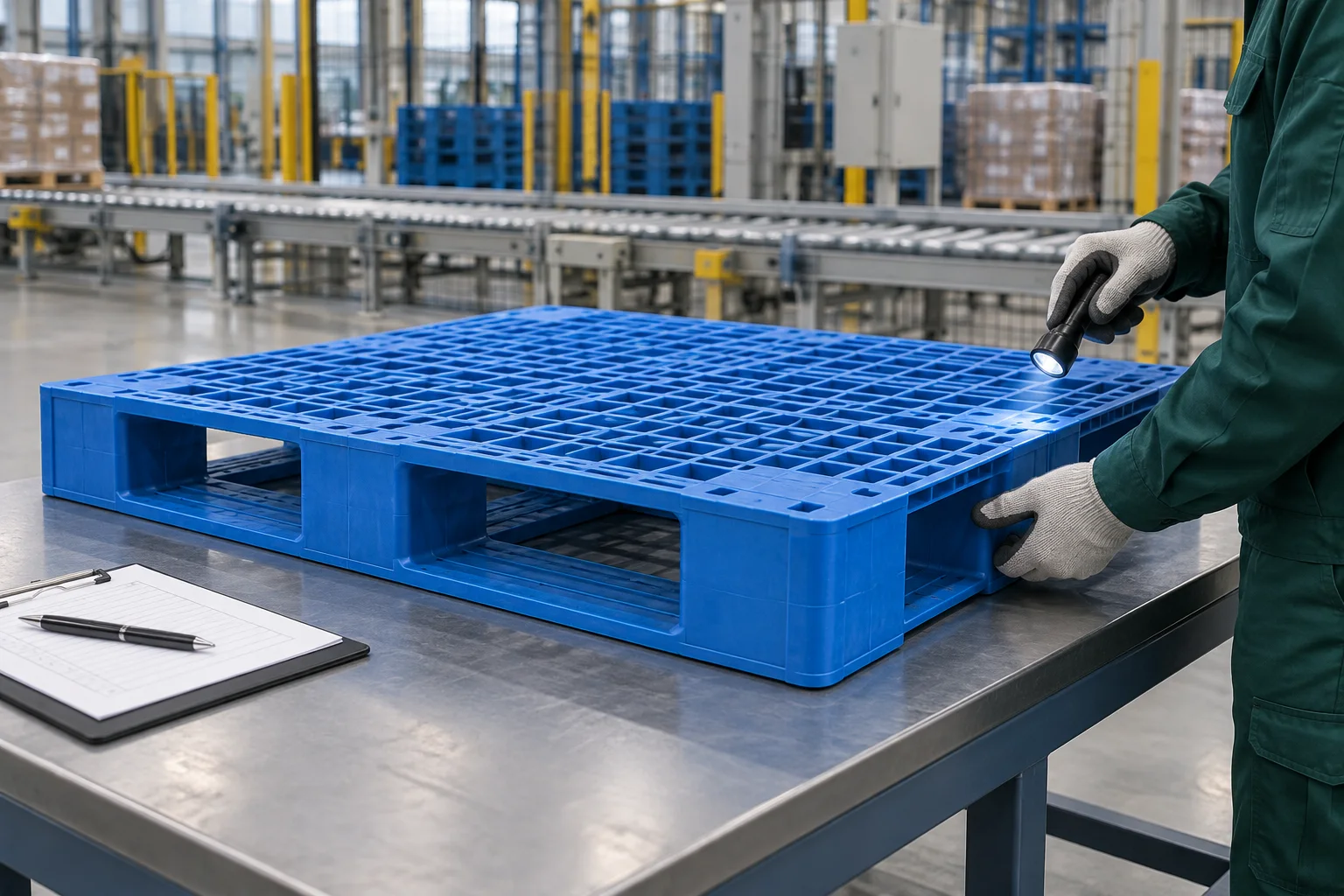
In this guide
Inspect an AS/RS plastic pallet before reuse, isolate damaged or questionable units, and record who can approve their return. In an automated warehouse, the inspection record should also identify the pallet model and the interfaces where it is supported, lifted, guided and detected. A pallet that looks familiar is not necessarily the approved configuration.
This guide helps warehouse operators, maintenance teams and buyers organise that record. It separates visible-condition checks from route-specific compatibility checks, then turns the findings into a clearer replacement enquiry.
1. Put inspection at the return and infeed points
The UK HSE’s Pallet safety guidance, PM15 recommends checks on delivery and at each use, with damaged units identified and removed from circulation. Use that as general guidance when setting your local procedure; agree responsibilities and the actual inspection method for your site.
For an AS/RS workflow, useful review points include receipt of new pallets, empty-pallet returns and the last accessible station before automatic infeed. Add a review after an impact, jam, unusual transfer or change in operating conditions. Record the event and location instead of simply returning the pallet to the empty stack.
Carry out close inspection at a designated station. If a pallet is trapped in machinery, follow the site’s recovery and isolation procedure through authorised personnel. Interroll’s Pallet Drive manual, section 2.5 warns against reaching between moving components and calls for protection against unexpected startup during fault work. The installed system’s own instructions govern recovery.
2. Check the plastic pallet’s visible condition
Inspect accessible upper and lower surfaces using the site’s safe handling arrangement. HSE PM15’s plastic-pallet checklist highlights damaged decks and bases, cracked or worn supports, permanent distortion, trapped debris and environmental deterioration; it also directs users to the manufacturer for further advice. Its examples are useful starting points, not a substitute for model-specific criteria.
Use the following record to make observations traceable:
| Area | Observation to record | Evidence for review |
|---|---|---|
| Deck and corners | Location of broken grid sections, cracks or missing material | Overall top view and close-up with a size reference |
| Runners and base | Wear, separation, damage or permanent change in shape | Underside view; mark the affected runner and side |
| Fork and pickup openings | Damaged entry edges or an obstruction | Photograph the opening and identify the pickup direction |
| Surface and cavities | Contamination, debris or signs of environmental damage | Note exposure history and cleaning status if known |
| Identification | Model, batch or asset number; any uncertainty | Photograph markings and link the approved drawing |
Keep the pallet on hold when a finding cannot be judged against agreed criteria. Appearance alone does not establish remaining load capacity. Obtain manufacturer advice on suspected material degradation; HSE specifically identifies a white, powdery surface as a rejection sign.
3. Review the interfaces used by your AS/RS
The following are project review questions, rather than universal reject limits. Ask the automation provider which drawing surfaces and dimensions matter at each station.
| Interface | Question for the pallet and equipment review |
|---|---|
| Roller conveyor | Does the runner contact match the approved orientation and support arrangement? |
| Chain transfer | Are the intended contact zones present and unobstructed? |
| Shuttle or stacker-crane pickup | Are the pickup openings and underside consistent with the approved drawing? |
| Rack position | Does the pallet correspond to the agreed support direction, span and configuration? |
| Guides, stops and sensors | Are the referenced surfaces and identification features still present and usable? |
A useful fault record might say: “Pallet P-017, runner B, scraping reported at transfer T-04 after a corner impact; underside photograph attached; held for review.” That gives the team an identifiable unit, location and next action. “Pallet does not run well” leaves all three unclear. This is an illustrative record, not a reported customer incident.
Compare recurring marks across several units. Similar damage at one transfer is a reason to review both the equipment interface and handling practice, rather than treating each pallet as an isolated purchase problem. Our conveyor and shuttle specification guide explains the drawings and interface information to collect.
4. Separate hold, release and replacement decisions
Use explicit status labels so a pallet awaiting a decision cannot be mistaken for available stock.
- Hold: identify the unit, prevent return to the route and assign a reviewer. Record the unresolved observation and supporting photographs.
- Release: record the applicable criteria, review result, approver and date. A completed cleaning action or an empty pass through infeed is not, by itself, evidence that structural or loaded-operation questions have been resolved.
- Replace or retire: record the reason and prevent unintended reuse. Follow the owner’s disposal or recycling arrangements.
If repair is proposed, obtain a method and return-to-service criteria from the manufacturer or responsible pallet owner before proceeding. Do not improvise by trimming an interfering runner, drilling the base or altering reinforcement to make a pallet fit. Treat any resulting configuration change as a new compatibility question.
There is no single crack length, wear depth or replacement age specified by this article. Agree measurable criteria for the particular pallet and equipment, including the measurement location, condition and method. A repeatable inspection process needs a decision owner as well as a checklist.
5. Download the inspection record
Use one record per pallet or identifiable issue. Leave unknown information marked to confirm and keep photographs with the record.
| Record field | What to enter |
|---|---|
| Identification | Asset or batch ID, model, drawing revision, inspector and date |
| Operating context | Station, orientation, payload, support arrangement and temperature |
| Finding | Affected part, visible condition, event history and photograph references |
| Criteria | Manufacturer or system document, revision and relevant criterion |
| Action | Hold location, reviewer, next action and target review date |
| Outcome | Release, continued hold or retirement; approver and supporting evidence |
Frequently asked questions
Can a scratched plastic pallet stay in an AS/RS?
A scratch description alone is not enough to decide. Record its location and condition, then use the approved manufacturer’s criteria and the relevant equipment requirements. If its significance is uncertain, hold the unit for review.
Does passing the infeed check prove the pallet is safe for storage?
An infeed result applies to the checks actually performed there. Confirm what the station measures. It should not be treated as proof of an untested runner condition, loaded rack performance or a different pickup interface.
How often should plastic pallets be replaced?
Use the manufacturer’s instructions and your inspection findings for the actual service conditions. This guide does not set a calendar life. Keep age or cycle information where available so it can be considered alongside condition and incident history.
Must a replacement have the same dimensions?
Matching length and width is only part of the review. Confirm the base geometry, pickup clearances, material and reinforcement configuration, loaded envelope and equipment requirements. Validate changes through an agreed sample acceptance plan.
Prepare a replacement pallet enquiry
Contact BAOHENG with the current pallet model, top and underside photographs, defect location, route drawing, payload and loading pattern, support details, operating temperature and required quantity. Include the equipment provider’s acceptance criteria and distinguish confirmed information from open questions.
Use the plastic pallet catalogue to identify candidate families and the rack-load guide to organise the support and storage conditions. A replacement decision should address the observed problem and the intended route together.
Sources and image notes
- HSE — Pallet safety, PM15, fourth edition, pages 6 and 12: general inspection and plastic-pallet condition guidance. This UK guidance is cited for its practical content, not as a statement of legal requirements in every country.
- Interroll — Pallet Drive operating instructions, version 1.3, section 2.5: machinery hazards and fault-work precautions. Follow the manual applicable to your installed equipment.
- The interface questions, workflow and downloadable record are BAOHENG editorial planning aids. They do not report a completed inspection, certify a pallet or define universal acceptance tolerances. The cover is AI-generated.
