AS/RS Pallet Color and Sensor Detection: A Buying Checklist
Before approving a pallet color, confirm how the warehouse detects the pallet. Record the sensing method, target surface and sample-trial result together.
In this guide
Plastic pallet color can affect photoelectric detection, but color alone does not determine AS/RS compatibility. The sensing method, surface geometry and actual operating arrangement also matter. Before a bulk order, agree what each sensor must detect and validate the proposed pallet configuration with the system provider.
For purchasing, the useful question is: will this pallet, in the supplied color and finish, be detected at every required station? A color name, catalogue photograph or successful test with another pallet does not answer that question.
1. Define the detection task before choosing a color
Create a station list covering infeed, conveyor accumulation, centring, lift, shuttle pickup and outfeed as applicable. At each station, identify whether the sensor detects the pallet base, the goods, a wrapped load or an identification label. These are separate tasks.
Photograph the mounting position and mark the intended target on a pallet side view. Ask the system provider to record the sensor model, sensing method, working distance, target height and expected output. Where the controller needs continuous presence between the leading and trailing edges, make that requirement explicit.
OMRON’s photoelectric sensor guide distinguishes methods that detect interrupted light from those receiving light reflected by the object. For diffuse-reflective sensors, it identifies surface color and smoothness as influences on detection. That is a reason to check the actual sensor arrangement rather than approve a color in isolation.
2. Match the review to the sensing method
Use this table to prepare questions for the equipment supplier. It does not select a replacement sensor or authorize a setting change.
| Sensing method | Basic principle | Project question |
|---|---|---|
| Diffuse-reflective | Receives light reflected by the target | Does the actual pallet color and finish provide a stable result at the installed distance? |
| Through-beam | Detects interruption between a separate emitter and receiver | Does the intended pallet area interrupt the beam throughout the required detection interval? |
| Retro-reflective | Detects interruption of light returning from a reflector | Are the reflector, pallet openings and any film included in the trial? |
| Background-suppression type | Uses distance discrimination to separate a target from a background | Are the target and background within the selected model’s stated operating conditions? |
The first three principles follow OMRON’s guide. SICK’s photoelectric laser sensor overview, page 8 explains background suppression by triangulation. These descriptions do not establish that every model performs identically.
Do not assume that a dark pallet is unsuitable or a blue pallet is automatically suitable. OMRON’s engineering notes show that reflectance depends on the relationship between surface color and light wavelength. A human-visible color match is therefore not a sensor approval method.
3. Mark the actual sensing surface on the pallet drawing
A pallet has more than one optical target: a corner block, deck edge, runner, rib or opening may cross the sensing path as it moves. Mark which face the station should use, the travel direction and the allowed position variation. Show any opening that can pass through the sensing zone.
For example, a beam aimed at a fork opening may encounter a different target pattern from one aimed at a continuous solid area. Whether this produces an unwanted signal depends on the sensing arrangement and control requirement. This is a review question, not a diagnosis that applies to every conveyor.
Leuze’s palletizing applications discuss dedicated detection of irregular objects with openings, film-wrapped pallets and load dimensions. Those distinct applications support reviewing geometry and packaging alongside color.
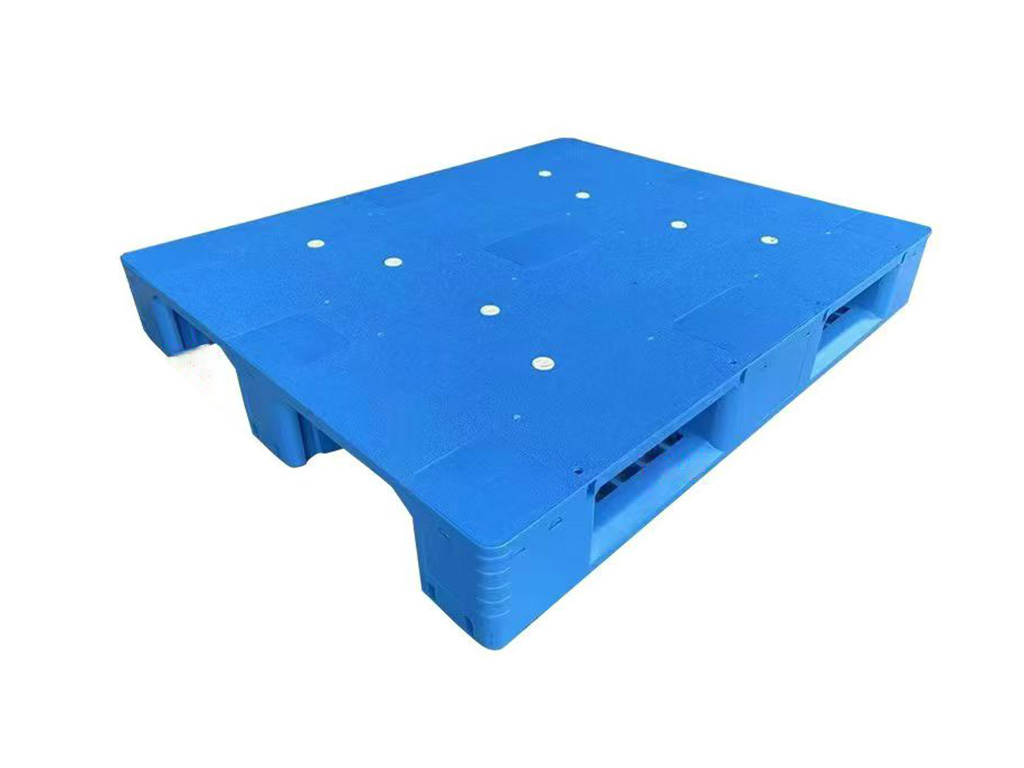
The BH1210 Solid 3-Runner catalogue photograph below helps identify visible faces and openings. It does not establish a sensing height, sensor model or approved mounting position.
For the mechanical route review, use the conveyor and shuttle specification guide.
4. Trial the supplied configuration and the complete load
Give each sample an ID. Record the pallet family, model, drawing revision, agreed material specification, color reference and surface condition. If the proposed production color differs from an earlier sample, keep that difference visible in the approval record.
Have the system provider define the trial conditions and acceptance criteria before the run. The following is a practical planning checklist:
- Empty pallet: verify the intended target at each required station and orientation, including the agreed position variation.
- Representative loaded pallet: include the actual packaging and wrap arrangement where they enter the sensing zone. Empty-pallet approval does not cover a different optical target.
- Operating sequence: check the required entry, presence and exit signals under the agreed speed, stopping and restart conditions.
- Service conditions: include relevant lighting, temperature and surface conditions within the approved operating specification. Record exclusions rather than assuming they were tested.
- Controller result: retain the observed input or event record as well as the sensor indication. Note missing, extra or interrupted signals against the expected sequence.
The system provider should set the sample quantity, repeat count, allowable errors and any signal-margin requirement. This guide supplies no universal values. Keep personnel outside moving equipment and use the site’s approved trial procedure. Process presence detection also does not establish a personnel-safety function.
5. Keep color and sensing approval in the purchase record
A short written record makes it easier to distinguish an approved configuration from an unresolved proposal.
| Record | Information to retain |
|---|---|
| Pallet configuration | Family, model, drawing revision, sample ID, color reference and finish |
| Detection station | Station ID, sensor model, target face and mounting arrangement |
| Trial scope | Load, wrap, orientation, operating sequence and conditions included |
| Result | Expected and observed signals, exceptions and linked photos or logs |
| Release decision | Approved, conditional or unresolved; responsible reviewer and date |
| Change review | Who assesses a later color, finish, geometry, packaging or sensing change |
Keep the record alongside the pallet sample acceptance checklist. Sensing is one part of approval; rack support, load performance and mechanical transfers still need their own evidence.
Frequently asked questions
What is the best plastic pallet color for an AS/RS?
This guide does not rank colors. Select the proposed color with the pallet supplier, then confirm detection against the actual sensors, target surfaces and operating arrangement. Blue is not an equipment-compatibility certification.
Can a black plastic pallet be used with photoelectric sensors?
It may be suitable for a particular arrangement, but a color description alone cannot confirm it. Ask the equipment supplier to review the sensor’s specifications and trial the actual sample. Do not reject or approve it solely because it is black.
Can we approve a custom color from a photograph?
A photograph can support a visual discussion. It cannot reproduce the installed sensor’s wavelength, distance, target geometry and background. Request a representative sample and an agreed detection trial.
Should we repeat checks after changing the pallet or packaging?
Ask the responsible reviewer to assess whether the change affects the approved sensing target or trial scope. Record the decision and any required repeat checks, especially when geometry, color, finish or wrap placement changes.
Prepare a pallet enquiry
Send BAOHENG your pallet and sensing requirements: the required footprint, load conditions, preferred color, marked target surfaces and available station drawings. We can discuss candidate pallet configurations and the samples to put forward for your system provider’s review.
Our custom color and logo FAQ explains that color options, minimum quantities and color tolerance are confirmed with the quotation. A color option does not imply an approved sensor result.
Sources and image note
- OMRON — Photoelectric sensor overview: sensing principles and surface influences.
- OMRON — Photoelectric sensor engineering information: wavelength, surface reflectance and operating data.
- SICK — Photoelectric laser sensors, page 8: background-suppression principle.
- Leuze — Sensor solutions for palletizing: examples involving pallet openings, film and load profiles.
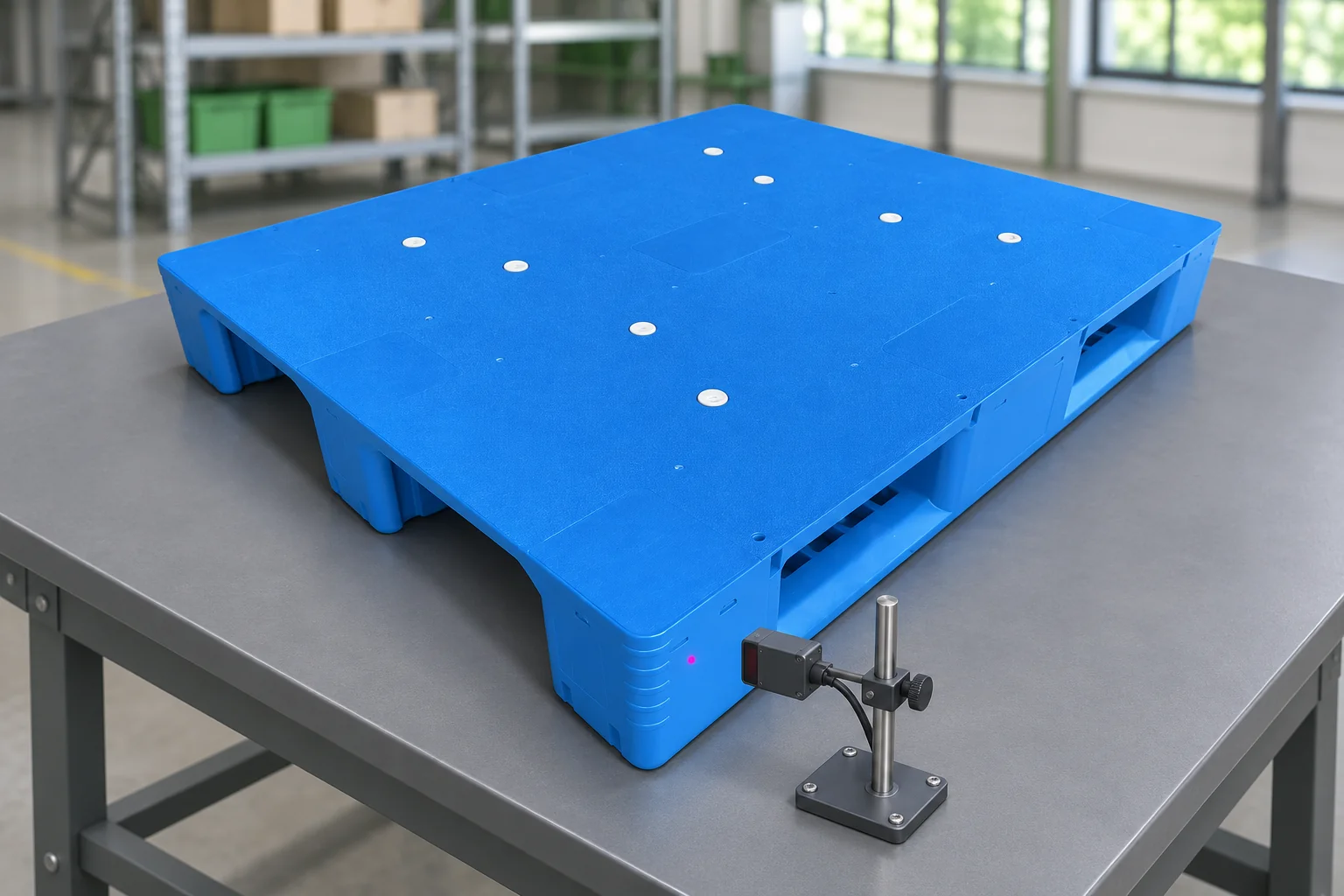
Sources reviewed on 5 November 2026. The station checklist and purchasing workflow are editorial recommendations, not reported BAOHENG test results. The cover uses an existing product photograph as a reference in an AI-generated scene; the separate catalogue image above is the original website asset.
